InSight
Summary
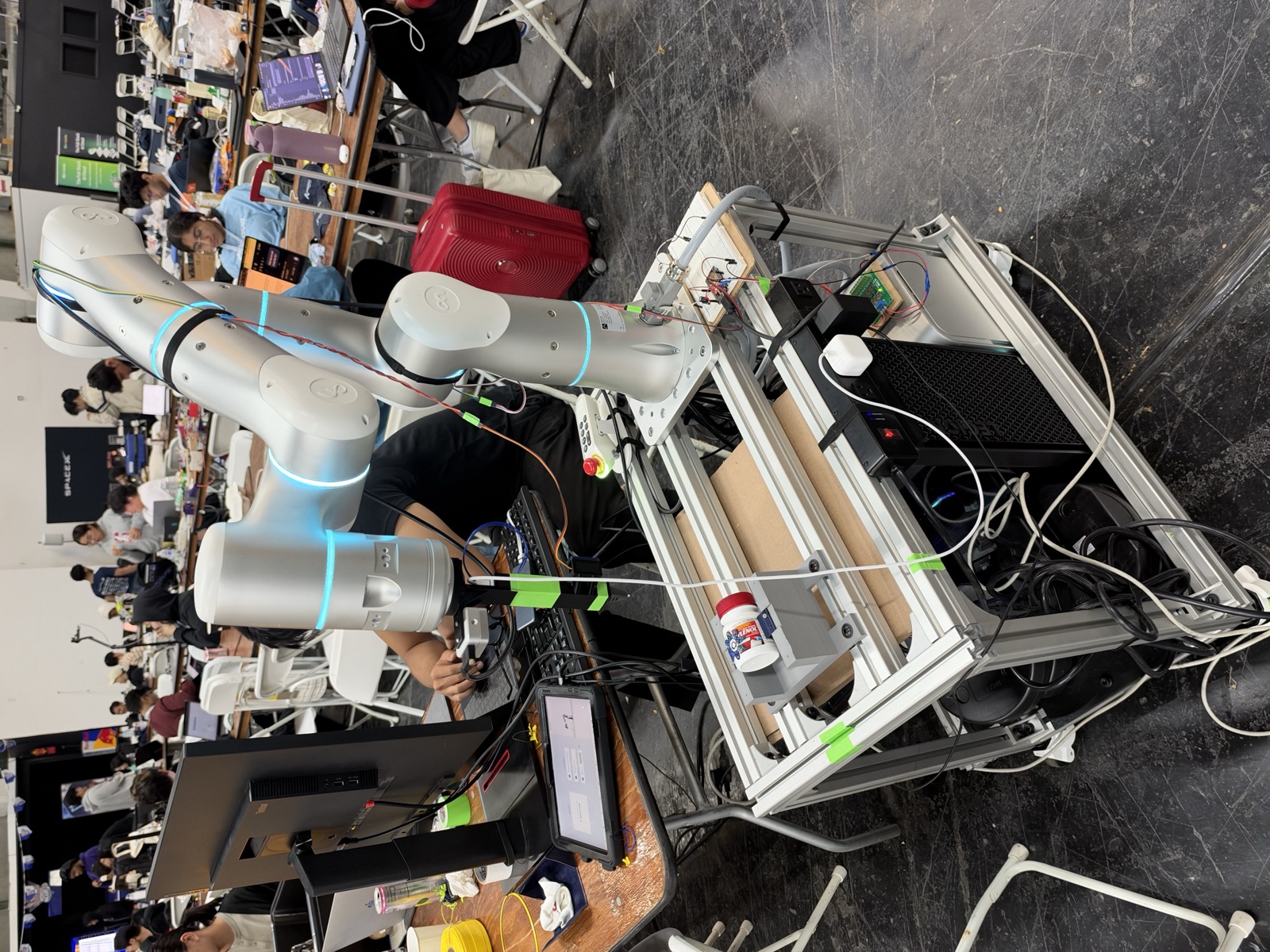
InSight turns any image into a raised tactile relief that blind and low-vision people can read with their fingertips, drawn directly onto the object it belongs on. Given an image and a target surface (plane, cylinder, or sphere), it extracts the major edges as tactile ridges and uses a 7-DOF Flexiv Rizon 4s holding a 3D pen to draw them onto the surface. Unlike a 3D printer, which can only build upward on a flat bed, the arm can hold the pen at almost any orientation, so it can draw on curved objects like pill bottles and Halloween decorations. The pipeline runs in six stages across 8 ROS2 packages, with no deep learning: every stage is classical vision, geometry, or control.
What I did
- Extracted the major image edges with OpenCV and mapped them onto each surface, wrapping the image around cylinders and using stereographic projection for spheres.
- Generated Cartesian toolpaths with clearance checks, keeping the pen within 35° of the surface normal, smoothing velocity at kinks, and avoiding the surface between strokes.
- Wrote a C++ executor that switches between a joint controller for approach and park and a Cartesian controller for drawing.
- Fixed uneven beads on curved surfaces by tracing them to the Cartesian controller not interpolating between targets, then streaming TCP targets at 1 kHz to match the control loop.
- Wrote ESP32 firmware that drives a servo to press the pen's extrude button from the robot's digital output, with debouncing, a safe boot state, and a 2 s press timeout.
- Designed a pen holder for the arm and fixtures to hold each object (tile, sphere, pill bottle) in Onshape.
Results
- Drew on flat tiles, cylinders, and spheres with one pipeline: a Cal Hacks venue map, a Jack-O-Lantern sphere, sun and moon labels on a Tylenol bottle, and a raised outline on a family photo.
Skills
ROS2
Python
C++
OpenCV
ESP32
Motion Planning
Cartesian Control
Onshape